Letters from Ukraine No. 1
25/9/2026
Greetings, and Parliamentary Diplomacy at Its Finest: Speaker Mori’s Visit to Ukraine
September 22, 2026
Ambassador Extraordinary and Plenipotentiary of Japan to Ukraine
Yo Osumi
Three Weeks Since My Arrival
I arrived in Kyiv on August 29. I saw my first Ukrainian sunrise from inside a car. All there was to see was blue sky, greenery and sunlight. Because we were speeding across flat, featureless land, the conifers on either side of the road almost blocked the view. It was a strangely surreal morning.I have previously been posted to New York, Riyadh, The Hague, Paris, London, Tel Aviv and San Francisco, but settling into an unfamiliar city is always unsettling—all the more so in a place where air-raid sirens sound from time to time. Even so, what encouraged me was that the Embassy colleagues who came to greet me were cheerful and high-spirited, and the warmth and atmosphere created by the local staff.
 In the three weeks since, my activities as Ambassador have been posted regularly on the Embassy’s X, Facebook and Instagram accounts, so I hope you will take a look (and, if you can, please press the follow button!).
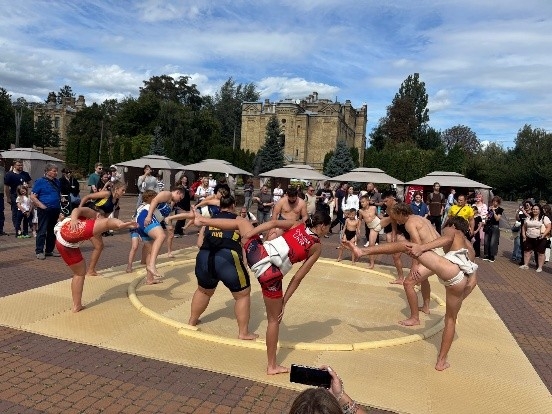
To share one episode: Ukraine is the home country of the sumo wrestler Aonishiki in Japan, so sumo is quite popular here, and at the open-air dohyo (sumo ring) at the “Japanese Autumn” festival held at Kyiv Polytechnic Institute on September 5, I had the chance to take on an amateur wrestler (a top competitor in Europe, I should add) — the son of the coach who trained Aonishiki. Of course, I won… September 5 happened to be my birthday, so perhaps I was also handed a little birthday present?!
What I Hope to Convey Through “Letters from Ukraine”
The starting point of my work here as Japan’s Ambassador is, as set out in the message of greeting on the Embassy’s website, “respect for the people of Ukraine—Japan stands with Ukraine.” Japan’s support for Ukraine rests on the steady backing of the Japanese people, and for that to continue it is important that people understand the real Ukraine of today, beyond fragmentary news reports. I decided to write “Letters from Ukraine” in the hope that sharing what I feel in the course of my work here, from my own perspective, may prove useful. To readers in Ukrainian, I wish to convey respect, solidarity and friendship. And to readers in English, I hope to offer a perspective from Asia on a Ukraine that tends to be viewed mainly through Western eyes.In Japan, war and peace are opposites, but there is a gradation depending on the country and region, and in this country they are, quite literally, next door to each other. To write about that complexity is not possible in a short post on X. And with the whole country gritting its teeth and bearing its grief, it is also hard to post carefree, cheerful photos and comments on Instagram. I have therefore decided to write in this old-fashioned style of prose.
The Power of Parliamentary Diplomacy—Speaker Mori Eisuke’s Visit to Ukraine
As it was covered in the Japanese press, some of you may already know that Speaker of the House of Representatives Mori Eisuke visited Ukraine on September 14–15. Speaker Mori is a “well-digger”: a founding member of the Japan–Ukraine Friendship Parliamentary League, formed in 1995, he has devoted himself to friendly relations between our two countries for more than thirty years. He received in Tokyo almost all of Ukraine’s successive presidents and prime ministers, President Zelenskyy included, and this was his own fourth visit to Ukraine, following those in 2013, 2015 and 2019. In view of his distinguished service, and because the Speaker of the House of Representatives is the head of the highest organ of state power, the Ukrainian side gave Speaker Mori a special welcome. Speaker Stefanchuk of the Verkhovna Rada—Ukraine’s parliament, the counterpart of Japan’s Diet—personally met him on arrival and saw him off on departure, and hosted a heartfelt dinner. He also met with President Zelenskyy and Prime Minister Koretskyi, but the highlight was his 20-minute address to the Verkhovna Rada.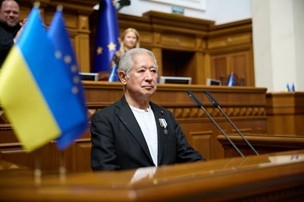 Wearing a vyshyvanka, the traditional Ukrainian embroidered shirt, with the decoration he had just been awarded by the Verkhovna Rada pinned to his chest, Speaker Mori stepped up to the rostrum with a resolute expression. He affirmed that the will of the House, expressed in the House of Representatives resolution he had worked hard to secure just before Russia’s full-scale invasion in 2022, remains unchanged, and said: “We will not yield to Russia’s attempts to shake us. We will continue to support Ukraine, and we intend for our two countries to work closely together and respond resolutely.” He went on: “The wounds borne by Ukraine as a nation, and by each and every one of its people, are deep and great, and it is hard to imagine that they will ever fully heal. When I consider the helpless anger and bottomless sorrow that lie behind Ukraine’s maervellous tenacity and strength, I cannot simply compare Ukraine’s path with that of my own country. Indeed, perhaps we should refrain even from making such comparisons. . . .” He closed with the words, “Our feelings of respect and solidarity toward the people of Ukraine, who defend freedom and democracy, will never change. Japan and the Japanese people will continue to stand with Ukraine,” and the chamber responded with standing ovation. The speech was received very warmly, and I believe it made a strong impression that a friend had come all the way from Japan to deliver such a powerful message to all the representatives of the Ukrainian people.
As a diplomat, my job is to move from place to place around the world, and I take pride in that; precisely for that reason, however, it is not always easy to sustain long-term relationships. That Speaker Mori, working hand in hand with Representative Moriyama, who accompanied him this time, has built up relations with Ukraine and kept up long-lasting exchanges is parliamentary diplomacy at its finest—something we diplomats cannot imitate—and I felt in this address to the Rada the force of the culmination of all that work.
“The God of Welding”—Dr. Evgeny Paton
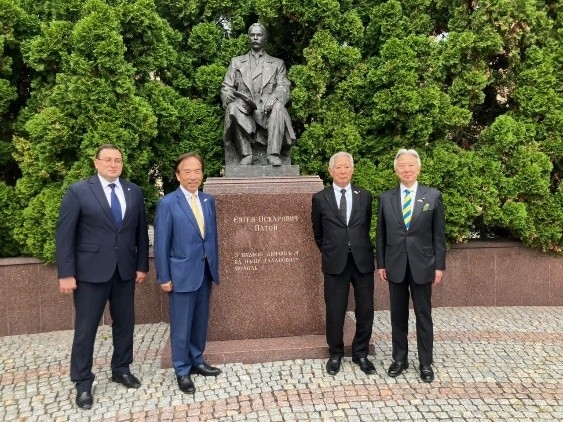 Throughout the eras of Imperial Russia and the Soviet Union before gaining independence, Ukraine has been a major center of science and technology. Kyiv Polytechnic Institute, which we visited on the first day, has produced a great many graduates and professors. Speaker Mori studied welding in the Faculty of Engineering at Tohoku University and went on to earn a doctorate, and he told us that the author of papers he read often at that time was a certain Dr. Evgeny Paton. When we visited Kyiv Polytechnic Institute on the first day, we learned that Dr. Paton and his son had both been active at this university, across two generations. The Speaker has the air of a taijin—a person of great stature—distinguished and quiet, but this one time he broke into a broad smile and had his photograph taken with the statue of Professor Paton. The meeting in Kyiv of the president of the Japan–Ukraine parliamentary friendship league and Dr. Paton, the “God of Welding”—it made me realize what remarkable bonds there can be. I understand there is also a “Paton Bridge” in the city that Dr. Paton designed, and I would like to go and see it next time.
From Kyiv, Bound for Tokyo
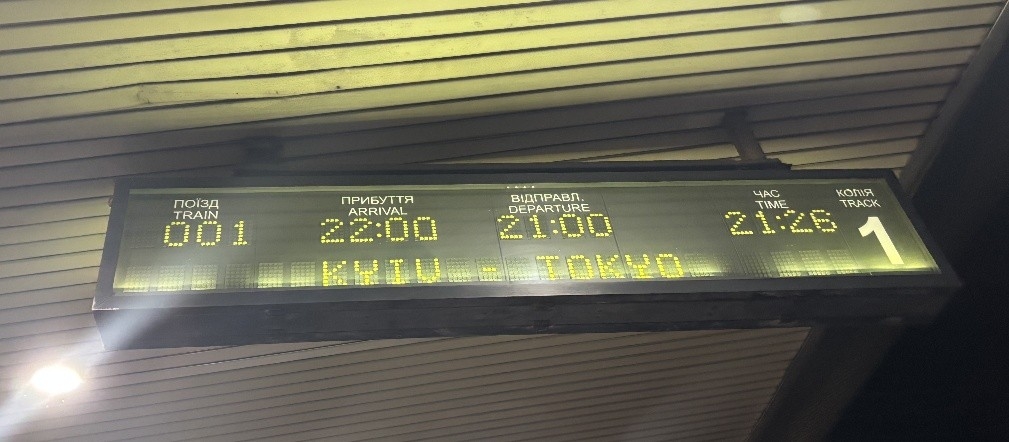
After the two-day program, Speaker Mori and Representative Moriyama left Ukraine, seen off by Speaker Stefanchuk, and boarded a train bound for Poland. Looking up, I happened to see the words “Departing Kyiv, bound for Tokyo” on the display board. What a witty hospitality!And then, gazing up at the night sky, I found myself thinking of my family in Tokyo.

 (82KB)