
Letters from Ukraine No. 2 — In Tokyo, I've Been Sleeping “Like a Child” —
“In Tokyo, I've been sleeping ‘like a child.’”
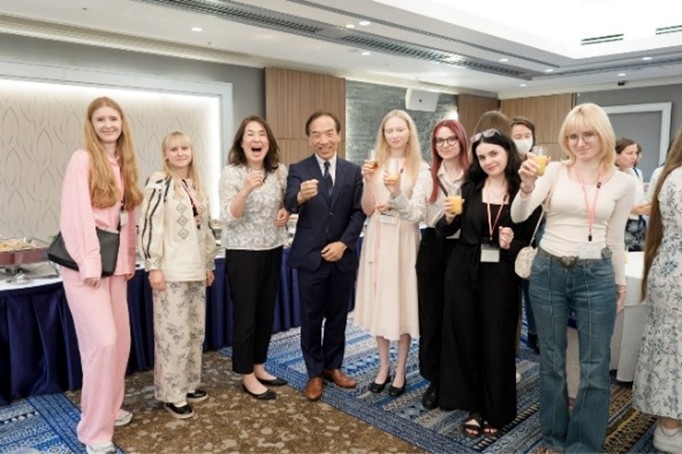
In August, the Japan Foundation invited a total of 24 people—two students and two teachers each—from five Ukrainian universities and the Japan Center in Kyiv. On August 17, a reception was held in Tokyo, which my wife and I also attended.
Mr. Kurosawa, President of the Japan Foundation, who was with us, told me: “The Japanese Language Proficiency Test (JLPT) is not supposed to be interrupted partway through. Given the circumstances in Ukraine, they had to administer the JLPT in underground shelters.”
I could feel how the war was affecting things in various ways. Before the reception, the representatives of the six entities gave a report on the current state of Japanese language education there. One of them said that when Russia's full-scale invasion began on February 24, 2022, a teacher posted a message to students in the group chat: “This week's classes are cancelled. I will contact you again about the future schedules. Please stay safe…” Four and a half years have passed since then, and the war still continues. The students said they had learned Japanese words that one would not normally learn in a lifetime, such as “evacuation,” “missile attack,” “air raid siren,” and “shelter.”
We also chatted with various participants, almost all of whom were women, as adult men are subject to restrictions on leaving the country. Everyone seemed to be enjoying their study trip to Japan. When my wife asked one of the women, “What do you like best about Tokyo?”, she answered, “Since the air raid sirens don't sound here, I've been sleeping like a child.” Hmm—“like a child”... That offhand remark stayed with me. I found myself hoping to meet these women again once I got to Ukraine.
Reunion
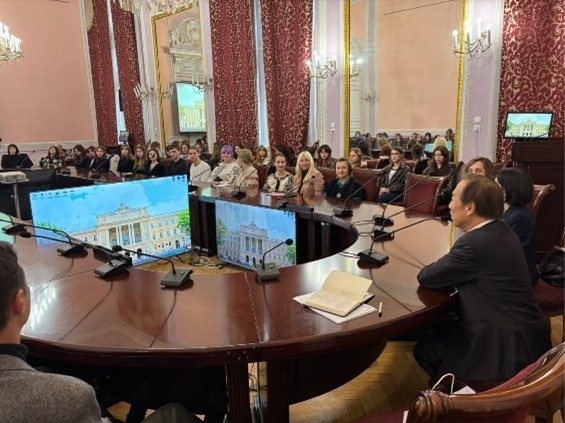
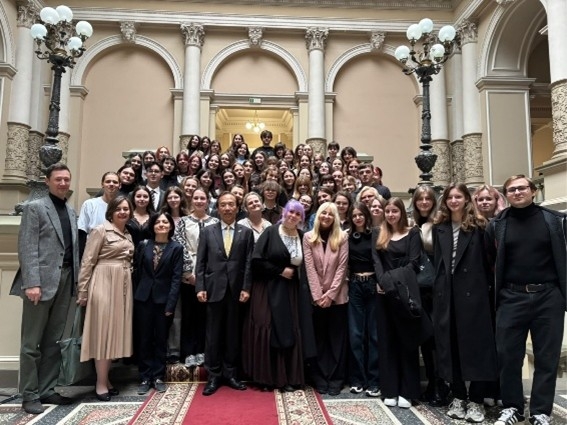
Lviv is a city in western Ukraine located 70 km from the border with Poland—a cobblestone town with a strong European atmosphere, shaped over its 760-year history by the mingling of many different peoples. Lviv National University was founded in 1661 under Polish rule and its classical architecture and red-carpeted staircases evoke a solemn sense of tradition.
The president and deans explained that a Japanese language course was established in 1992, that more than a hundred students currently study not only the Japanese language but also Japanese literature, culture, business communication, and interpretation/translation, and that this coming December will see the first-ever administration of the Japan Foundation's JLPT there. As one of Ukraine's leading universities, I could sense the high caliber of the institution.
Afterward, they said, “Well then, let's go meet the students,” and I assumed I would be meeting just a handful of the students and teachers who had visited Japan. But then—ta-da! In a large, high-ceilinged room that felt like a conference hall, nearly a hundred students and teachers were packed in, seated shoulder to shoulder.
Facing the full room, I first introduced myself, speaking every bit of Ukrainian I knew: “Добрий день. Мене звуть Осумі. А ім'я Йо, Йо означає океан. Дуже приємно. (Hello, my name is Osumi. My given name is Yo. Yo means ‘ocean,’ or ‘sea.’ Nice to meet you).” I had actually intended to add, “My ancestors were pirates long ago,” but I couldn't remember enough of it to get the words out...
I also conveyed condolences and sympathy, my respect, and the message that Japan stands together with Ukraine.
The students and teachers I had met in Tokyo were sitting in the front row. When I asked them questions about experiences in Japan, I got responses like, “I was able to fit in right away,” “It was wonderful to be able to interact with students of the same generation in Japan,” and “The secondhand bookstores were fun.”
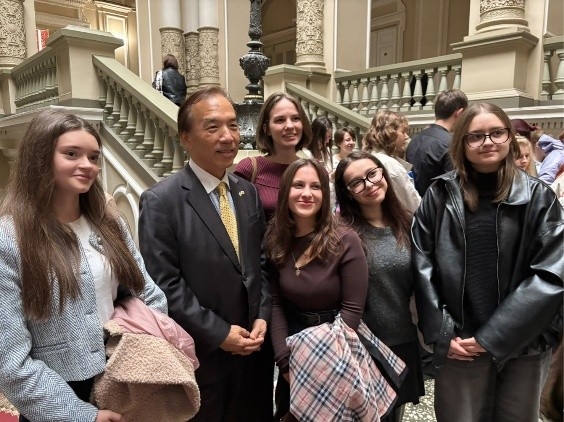
During the Q&A session with the whole room, I sensed a bit of shyness at first, but hands gradually began to go up. Some of the questions were quite difficult, such as “What will the future relationship between Japan and Ukraine look like?”, “What is the significance of learning Japanese today?”, and “What is the significance of studying the humanities in the modern era?” I answered that human wisdom exists in both the West and the East, that it is an intellectual loss for the West to learn almost nothing about the East even though Japan studies both, and that it is a good thing for their own lives that they can learn the wisdom of Japan and the East through the Japanese language. I also said that what is being questioned by the advance of AI is how humanity makes its ultimate choices, that this is something human beings themselves need to think through, that the compass for doing so is an understanding of history and philosophical thinking, and that the tradition of the humanities is needed now more than ever.
Finally, after taking photos on the red-carpeted staircase, various students came up to talk with me. I hope this visit will have raised everyone's motivation to keep studying Japanese.
“Budokan”
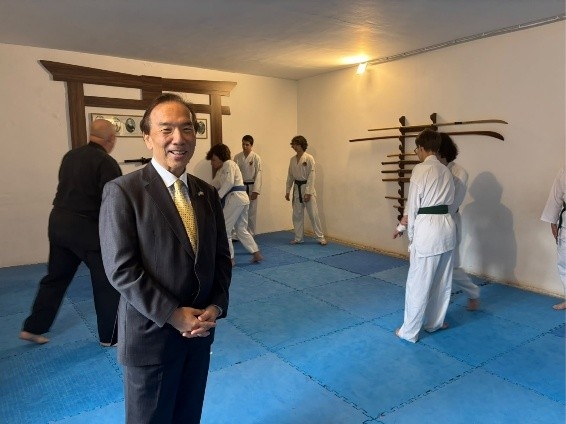
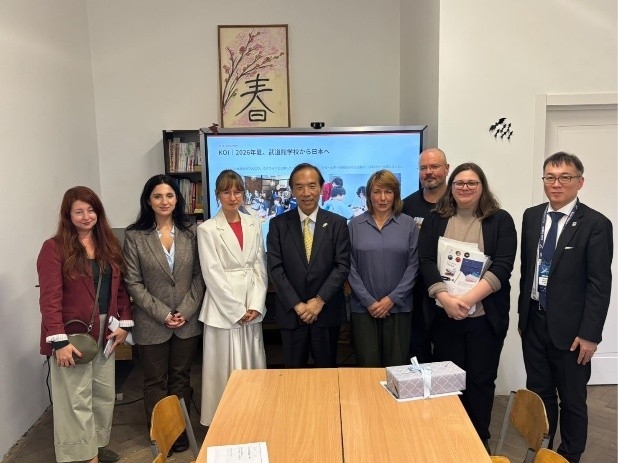
Finland is nearby, and Finnish-style education is well known in education circles, but I was curious why this traditional school in Lviv had arrived at “Japan,” so I asked about it, and it turned out that one of the people involved with the school was from Sakhalin Island off Siberia, where he had encountered Japanese martial arts, later studied Zen philosophy, and then come to Lviv—this connection seemed to be the origin of it all. It brought to mind the fact that the father of the great Showa-era yokozuna Taiho was a Ukrainian former Cossack cavalry officer who, after the fall of the Russian Empire, fled to Japan and lived in southern Sakhalin (which had been Japan's from 1905 to 1945). I have also heard that during the Stalin era, Ukrainians were relocated en masse to the Russian Far East. Perhaps this is one of the many stories connecting the Far East and Ukraine, sprouting in such an unusual form here in Lviv.
I was told that there is now a plan underway to create a “Lviv Japan Center” on the roof of this Budokan school. They also apparently want to create a co-working space called the “Japan-Ukraine Business Innovation Hub.” The Lviv city authorities also appear to be involved, and I could feel their tremendous enthusiasm to make it a hub for Japanese culture and to attract Japanese business as well.
Along with the Japanese language education at Lviv National University, I was grateful to see that in this town—largely unknown in Japan—so many students are studying Japanese and trying to build connections with Japan.
The Benches at the Cemetery
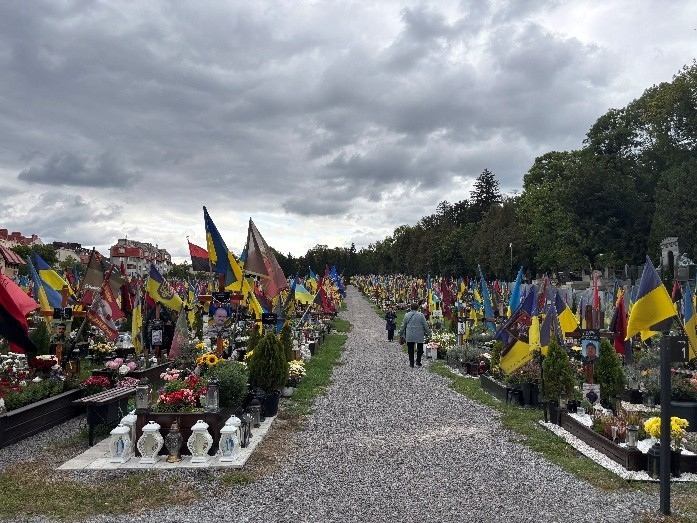
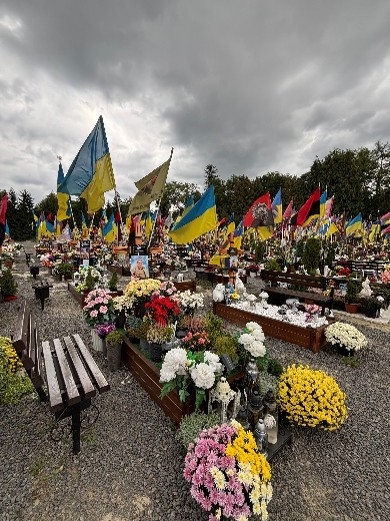
As the photos show, this cemetery stretches on and on into the distance, and we never made it all the way to the end. Around the new, well-kept coffins were photographs of the deceased, Ukrainian flags, and various flowers. Benches had been placed beside most of the coffins. Perhaps people wanted to stay close to those who had passed, to spend time by their side—in any case, a few of the benches had people sitting on them under the cold sky. Even here in Lviv, far from the eastern front, there is the sorrow of war. And was that sacrifice truly necessary in the first place? Beneath the heavy, overcast sky, all I could do was bow my head.
Back to Kyiv
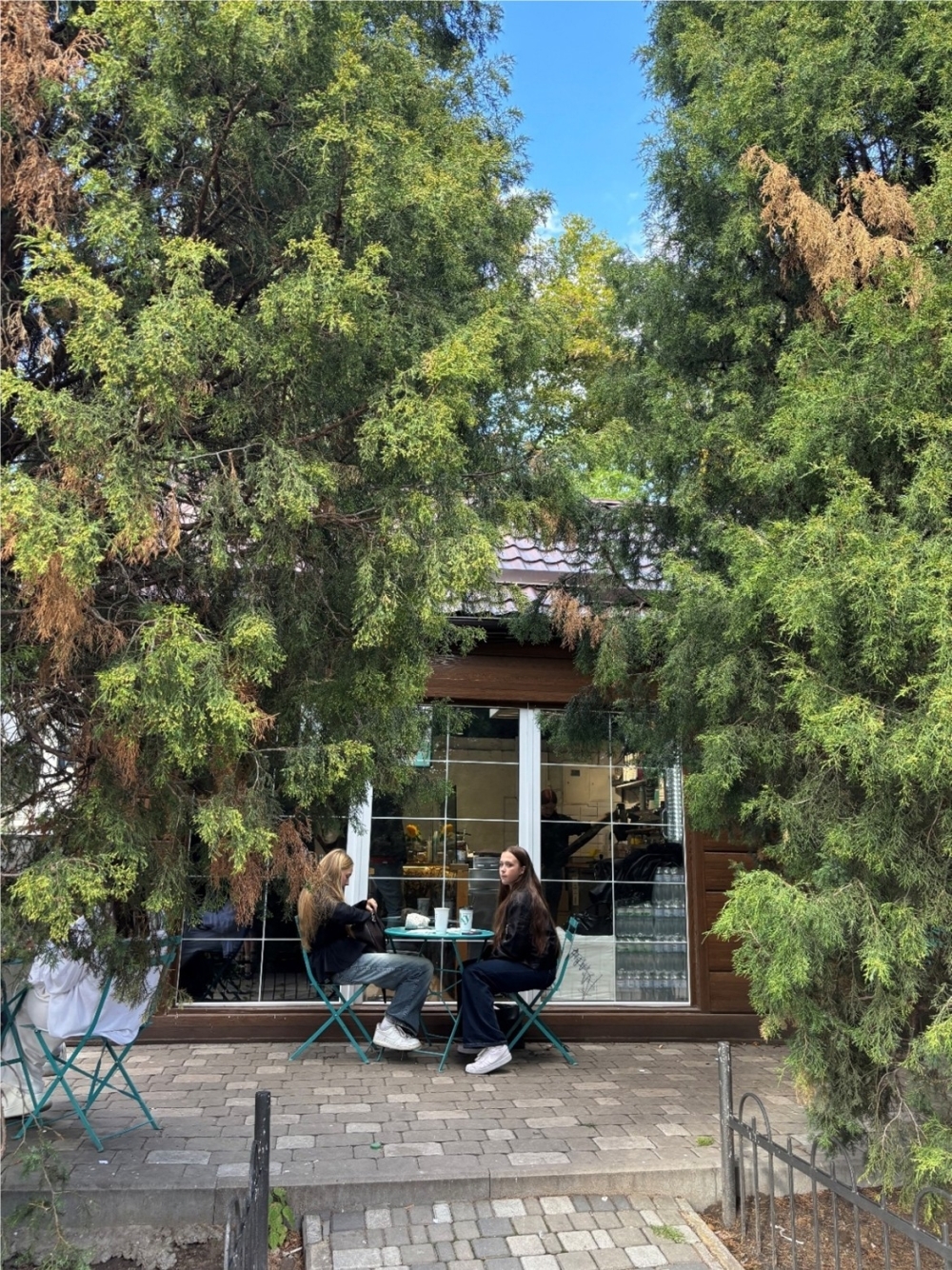
On the weekend, I took a walk in a nearby park for the first time. Without the air raid sirens, it would look like an ordinary scene. Even as peace and war stand back-to-back, the people are seeking to live their lives fully.

 (82KB)