
Letters from Ukraine No. 3 — A Letter to the Young Ballet Dancers of Ukraine —
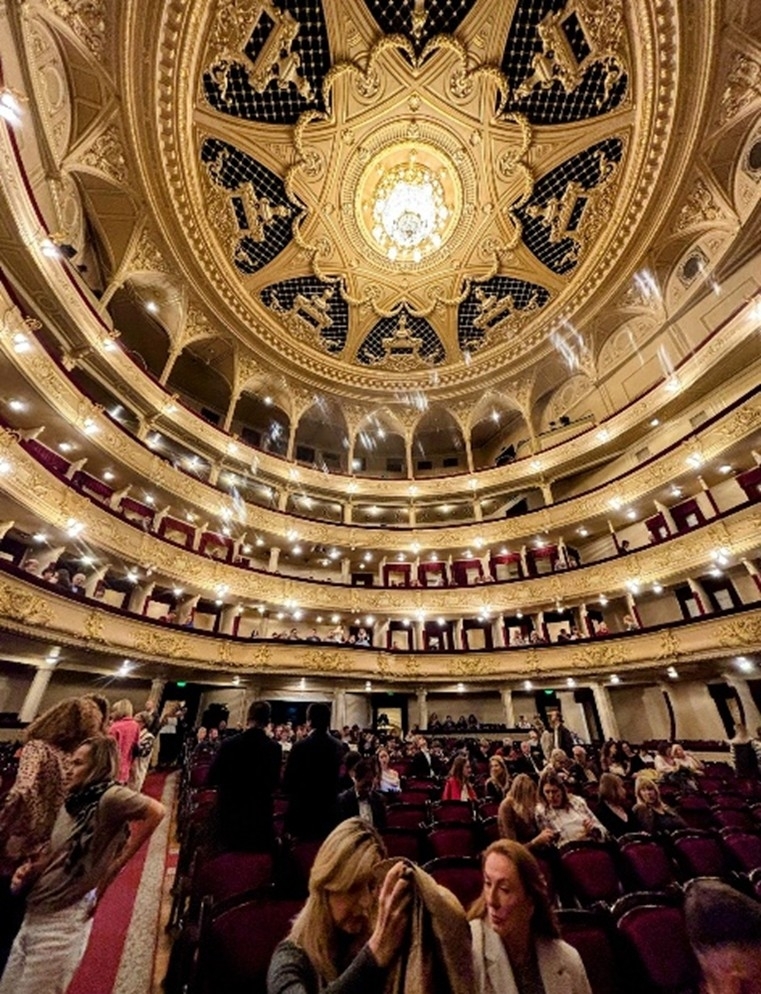
On the evening of Saturday, October 10, I visited the National Opera House in Kyiv at the invitation of Mr. Terada, Artistic Director of the National Ballet of Ukraine. Several embassy staff joined me. Medical Officer Goto arranged the outing to give them a break and a chance to recharge, as they have been worn down by the constant appearance of drones.
Director Terada was waiting in front of the theater, beaming. I imagine that previous ambassadors, too, have been welcomed just as warmly. Since the performance was about to begin, we exchanged only brief greetings before being shown to our seats. “Audiences have been small lately because of the air raids, but tonight the house is full,” he told us. The glamour of a theater filled with anticipation before the curtain rises is no different from that of any theater in the world. Yet I am still taken aback by the gap between the everyday and the extraordinary. Just one block away stands the building of the Academy of Sciences, partly destroyed by fire after a recent drone attack.
There were three works on the program.
The first, “Variations Donizetti,” is by the great master Balanchine, who was born in St. Petersburg of Georgian descent, emigrated to the United States after the Russian Revolution, founded the New York City Ballet, and pioneered the world of the “plotless ballet,” which has no story. A work can be staged only after the Balanchine Trust has strictly examined a company’s technical level and the quality of its dancers and granted approval; this time the National Ballet of Ukraine received permission and gave the piece its first performance. The dancers wore “classical tutus” designed by Barbara Karinska, another legendary costume designer, who came from Kharkiv in eastern Ukraine. Medical Officer Goto had told us, “It’s bright and fun, so just enjoy it,” and indeed it lifted my spirits.
During the intermission, Director Terada came over and told us his story. Born to parents who run the Terada Ballet Art School in Kyoto (a sister city of Kyiv), he went to study at the Kyiv National Ballet School in 1987 as the first Japanese student on a Soviet government scholarship, a connection that arose when Foreign Minister Shevardnadze visited Japan during the era of Soviet perestroika. Since “parents are not allowed to accompany a student studying abroad,” he came alone at the age of eleven. He later joined the prestigious National Ballet of Ukraine (then the Kiev Ballet), where he was active as a soloist, and in 2012 he became artistic director of the ballet school. Then came Russia’s full-scale invasion in February 2022. Members of the company, who had scattered around the world, gathered in Maebashi, a Japanese local city north of Tokyo, in the summer of that year and carried out the company’s first overseas tour since the invasion, visiting sixteen cities across the country. “Maebashi is our sacred place. They provided us with lodging and rehearsal space for a month in that summer, and we are still deeply grateful. We also give a concert there every year,” he said. His words reminded me of an NHK documentary that had covered members of Kyiv’s ballet company gathering in a provincial Japanese city.
The second work was “Spring and Fall.”
The women wore elegant white dresses and the men white trousers, with their muscular upper bodies on display, and they danced as one, expressing the shifting of human emotions and the changing of the seasons through dance. I was told that this contemporary ballet is the work of a German artist. Since the invasion of 2022, the Ukrainian ballet company has stopped performing Russian works altogether. The Russian language, once so ubiquitous, is no longer spoken at all in public, and English has become a quasi-official language, especially among the young. Resentment toward Russia runs deep: no one imagined it would go so far as to deny their very identity altogether and slaughter them. There is a powerful tide in Ukraine of turning away from Russia and toward Europe. We may be witnessing the birth of a true nation-state.
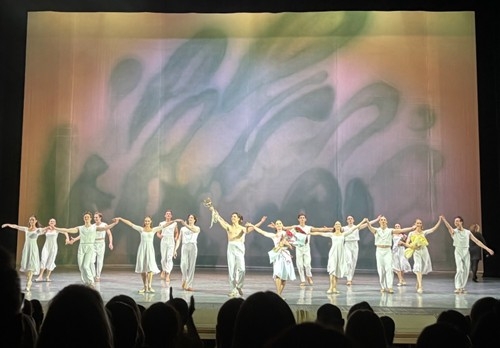
(The curtain-call scene after “Spring and Fall”. The stage lighting control system was installed with assistance provided by Japan.)
And the third work was “Wartime Elegy.”
I asked Director Terada: “I recall that the NHK documentary ended with the dancers scattering around the world. What happened afterward?” He replied, “Many of them came back after that. I once asked the dancers themselves why they had returned. They answered, ‘Because now we have to come back to Kyiv, carry on the tradition, and pass it on to the next generation.’ I too had evacuated when the full-scale invasion began, but when I returned to Kyiv for a time afterward, I was asked whether I would take on the role of director, and I made up my mind.” In December 2022, Mr. Terada became the first foreigner to be appointed Artistic Director of the National Ballet of Ukraine. “For 70 to 80 years they had been dancing the same repertoire, but once I became director, I resolved to take on new things eagerly,” he said.
Alexei Ratmansky, who choreographed “Wartime Elegy,” was born in Leningrad and raised in Kyiv, to parents from Russia and Ukraine. He danced with the Ukrainian ballet company, served as artistic director of the Bolshoi Ballet in Moscow, and is one of the foremost choreographers of our time (he currently works at the New York City Ballet, which Balanchine founded). When Russia launched its full-scale invasion of Ukraine in February 2022, he was in the middle of rehearsals at the Bolshoi Theatre in Moscow; he immediately abandoned the work, left Russia, declared that none of his works would be permitted to be performed in Russia, and has since spoken and acted for Ukraine. His wife, Tatiana, is Ukrainian, and she has relatives in Kyiv. Just a few months after the invasion, Mr. Ratmansky created this “Wartime Elegy.” It is now a signature piece in the repertoire of the National Opera. I was told that this time Mr. Ratmansky visited Kyiv, for the first time since the full-scale invasion, to work on the first piece, “Variations Donizetti,” and on this one. Mr. Terada also said, “People really do come to see this work. The fact that the house is full tonight is because this piece is being performed.”
The ballet, as the title “Wartime Elegy” suggests, opens with a scene in which comrades who have fallen on the battlefield are dragged away. The sorrow brought by the nobility of the dance; it feels as though each dancer’s own emotions made into it. In the middle section, groups of men and women in splendid folk costumes, separately, cheerfully perform a village youth dance, expressing the richness of Ukraine’s land and the strength of its people. The piece then returns to a monotone scene and ends with the dancers lifting their faces and moving forward, as if expressing hope for the future.
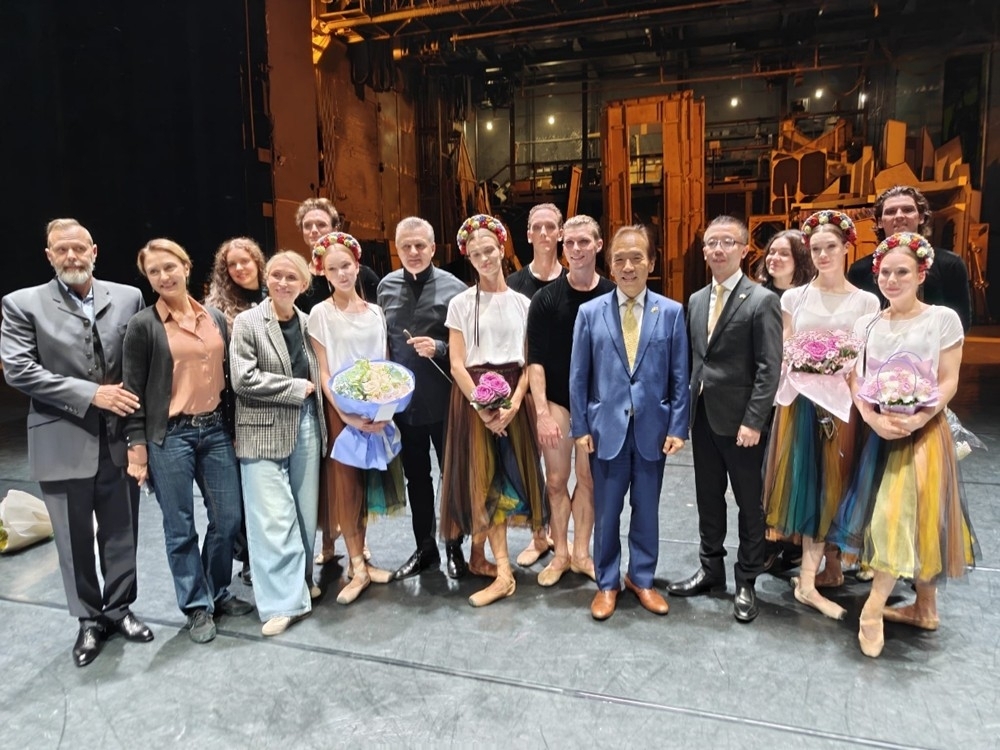
Vigor, sweat, and the tears that must be flowing inside their hearts. Graceful, poignant, and filled with quiet resolve. Art takes the emotions that well up in the human heart and lifts them into something transcendent. I was overwhelmed by each young dancer who cast off the dark shadows and lived fully in the “now,” a “now” that is neither yesterday nor tomorrow, throwing themselves wholly into the dance. The dancers I shook hands with backstage after the curtain were out of breath and drenched in sweat. Mr. Terada also told me, “This piece is truly grueling. It is physically demanding, of course, but with the war continuing, each dancer carries their own feelings, so it is mentally taxing too, and everyone is exhausted when it ends.”
Dancing with everything they had, they shook our souls and gave us strength. Is this not the power of art?
A Letter to the Dancers
Dear Dancers of the National Ballet of Ukraine,
On the evening of October 10, I watched your ballet at the National Opera House.
You showed me the splendor that is unique to contemporary ballet, from the light and joyful “Variations Donizetti” to the elegant and delicate “Spring and Fall.” Thank you very much.
And then, “Wartime Elegy.” To see this work in the Opera House in Kyiv, the capital of Ukraine, which is now exposed to war, held special meaning. Vigor, sweat, and the tears that must be flowing inside their hearts. Graceful, poignant, and filled with quiet resolve. I was overwhelmed to see each and every one of you dance with all your souls while fighting the shadow of this war.
Art takes the emotions that well up in the human heart and lifts them into something transcendent. Dancing with everything you had, you shook my soul and gave me strength. To awaken the noble spirit in us is, I believe, the highest calling of an artist. To you, the artists of this stage, my deepest thanks.
Mr. Terada told me that the reason many of you came back to Kyiv after Russia’s full-scale invasion in 2022 was, “Because now we have to come back to Kyiv, carry on the tradition, and pass it on to the next generation.” I thought, you yourselves are the very future of Ukraine. I believe you will shoulder the new Ukraine that lies beyond this suffering.
And just one more word. Just as when you rose again from your Japan tour in the painful summer of 2022, the people of Japan are with you.
October 15, 2026
Yo OSUMI
Ambassador of Japan to Ukraine
